

Spout pouches combine a flexible pack with a controlled pouring fitment and resealable cap. They are commonly considered for liquids, gels, pastes and refill products that need easier dispensing than an open pouch. The right specification depends on the product, fill process, barrier, spout position and cap.
Where spout pouches work well
| Product type | Why the format can work | Specification point |
|---|---|---|
| Drinks, juices and mixers | Portable, resealable and easier to pour | Product compatibility, filling temperature and tamper evidence |
| Sauces, purées and condiments | Controlled dispensing can reduce mess and help evacuate the pack | Product viscosity and spout diameter |
| Cosmetics and personal care | Useful for gels, creams, refills and travel formats | Compatibility with oils, fragrance and active ingredients |
| Household and automotive liquids | Lower empty-pack bulk than many rigid containers | Chemical compatibility, closure security and handling |
| Samples and trial packs | Allows repeated controlled use where a sachet would be single-use | Fill volume, cap size and customer safety |
Benefits of spout pouch packaging
- Controlled use: the spout and cap can make pouring and resealing easier.
- Efficient storage: unfilled flexible pouches occupy less space than equivalent rigid packs.
- Lower transport weight: the pack can be lighter than a bottle or tub, depending on the complete specification.
- Useful product evacuation: customers can squeeze a flexible pack to access viscous contents.
- Print area: front and back panels can carry branding, instructions and required product information.
- Format choice: sizes, finishes, barrier structures, spout positions and cap styles can be matched to the application.
How to specify a spout pouch
- Describe the product. Include its viscosity, ingredients, sensitivity to oxygen or light, filling temperature and intended shelf life.
- Confirm the fill volume. A nominal pouch size is only a starting point; product density and required headspace affect the working fill.
- Choose the spout and cap. The opening must suit the product flow while remaining convenient and safe for the customer.
- Choose the spout position. Centre and corner positions can suit different filling equipment, pack shapes and customer use.
- Match the material structure. Barrier requirements and product compatibility determine whether a clear, metallised or other laminate is appropriate.
- Test the complete pack. Fill, cap, store, transport and dispense the actual product before production.
Stock and custom printed options
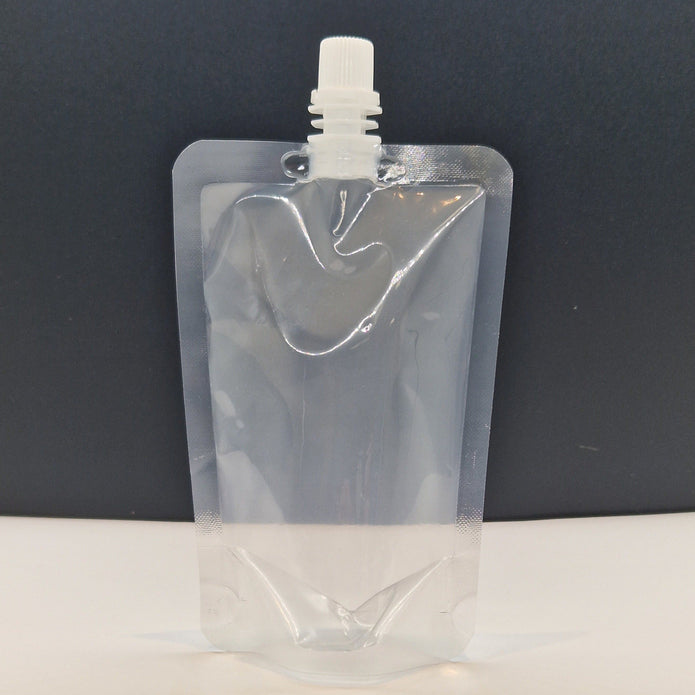
Stock pouches are useful for trials, shorter runs and applications where a plain format is acceptable. Examples include the clear centre-spout pouch and the larger black 5-litre spout pouch. Browse the full spout pouch collection to compare available formats.
Custom printed pouches give more control over artwork, finish and format when the order volume and specification support a manufactured run. Final dimensions, print method and lead time should be confirmed before artwork is approved.
Filling and sealing
Some pre-made spout pouches are filled through the spout and then capped; others may be supplied with an open area that is sealed after filling. The correct method depends on the pouch construction and your equipment. If your process requires a separate top seal, compare the available impulse heat sealers and test the exact pouch material. The pouch must lie flat across the seal line, with no product contamination in the sealing area.
Common mistakes to avoid
- Choosing a spout before testing how the real product flows.
- Using a volume estimate without allowing for density and headspace.
- Approving artwork before the pouch dimensions and spout position are fixed.
- Assuming one laminate suits every food, cosmetic or chemical product.
- Skipping filled-pack storage, leak and transport tests.
Test a spout pouch for your product
Start with the product and filling process, then choose the pouch around them. Request samples for practical testing, or request a custom-print quote when the format and specification are ready.